
rongwrong cave #1
HOW TO CURATE AN ARTIST IN REAL = i.c.w. ULAY
EXPERIMENT PERFORMANCE – LEARNING IN TEACHING PROGRAM
CURATED BY FLORENCE PAROT AND DIRTY ART DEPARTMENT (SANDBERG INSTITUUT)
AT RONGWRONG’S CAVE AND POSTNORMA
How to make a specific -spiritual and physical- environment to receive an artist and to live an immersive and corporal experience with him in Rongwrong’s cave and at Postnorma? Let’s define together what ‘performance’ and ‘to curate’ mean -it seems that the last decade those two words have been distorted- and then ACT to CURATE or CURATE TO ACT.
TRAINING I
March 7 & 14, 2015 – 11am - 7pm
March 8 & 15, 2015 – 2 - 7pm
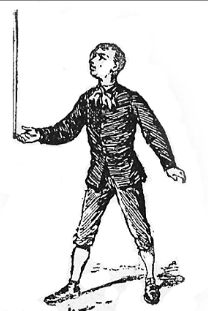
Experiment Performance (physical training, stick fighting, chilling, screening, treasure hunting, creating personal myth, sharing trans story telling and blind experience, then offering service)
With Pauline Curnier Jardin, March 7-8
With Janneke Raaphorst, March 14-15
@ RONGWRONG’S CAVE, AMSTERDAM CENTRUM
TRAINING II
March 30 & 31, 2015 – 11am - 7 pm
April 1, 2015 – 11am - 7 pm
Walk, nights and share solutions for performance modes
@SANDBERG INSTITUUT, AMSTERDAM ZUID
@ WALKING SOMEWHERE
@ KRUX AMSTERDAM, AMSTERDAM OOST
@ RONGWRONG’S CAVE, AMSTERDAM CENTRUM
DOING
Performance Workshop with Ulay
@ RONGWRONG’S CAVE, AMSTERDAM CENTRUM
Celebration of the end of the workshop
April 2, 2015 – 6pm
CURATING
May 2 & 3, 2015 – 11am - 7 pm
Exhibition of the Performance Workshop Archive
@ RONGWRONG’S CAVE, AMSTERDAM CENTRUM
Opening May 3, 2015 – 6pm
Exhibition from May 4 till May 17, 2015
SPACES
Rongwrong’s cave
Binnen Bantammerstraat n.2 - 1011 CK – Amsterdam Centrum
Open Saturdays and Sundays from 2 to 6 pm or by appointment ([email protected])
PostNorma, Dirty Art Department, Sandberg Instituut
Papavewerg 3C, Amsterdam Noord
-------------------------------------------
PARTICIPANTS
Florence Parot
Florence Parot is a French curator based in Paris and Amsterdam. She is in charge of the video collection of the Centre Pompidou; she recently co-curated the exhibition “Vidéo Vintage” at Centre Pompidou, Paris and all the touring at ZKM, Karlsruhe; Beirut Art Center, National Museum of Modern and Contemporary Art, Seoul. She is programmer of “Vidéo et après”, a cycle of screenings devoted to artists from the Centre Pompidou collection. She starts a PHD about history of performance played by outsized curators as Pontus Hulten (Moderna Museet, Stockholm, 1957-1973) and Ad Petersen (Stedelijk Museum, Amsterdam, 1960-1990). In the meantime she works as a tutor at Dirty Art Department (Sandberg Instituut, Amsterdam). She also initiates since 2011 “Châteaux Secrets”, inspired by utopias which encouraging self-construction and the return to nature. It offers artists to build the hut they’ve always dreamed of. The construction time is lived as an experience in itself, cooperation; a work of art…
Dirty Art Department & PostNorma, Sandberg Instituut
The Dirty Art Department –founded and run by Jerszy Seymour and Catherine Geel- offers itself as an open space for all possible thought, creation, and action. It sees itself as a dynamic paradox, flowing between the pure and the applied, the existential and the deterministic, and the holy and the profane. It is concerned with individuality, collectivity, and our navigation of the complex relationship between the built world and the natural world, and other people and ourselves. It’s a place to build objects or totems, religions or websites, revolutions or business models, paintings, or galaxies. The Dirty Art Department comes from a common background of design and applied art, it seeks however to reject the Kantian division between the pure and the applied arts. Since ‘god is dead’ and ‘the spectacle’ is omnipresent, it sees the creation of alternative and new realities as the way to reconsider our life situation on this planet. The Dirty Art Department is open to students from all backgrounds including designers, artists, bankers, skeptics, optimists, economists, philosophers, sociologists, independent thinkers, poets, urban planners, farmers, anarchists, and the curious. http://dirtyartdepartment.com/about/
PostNorma is a ‘squat squat’ slash up and coming art space in Amsterdam North. The space represents a happening of a class of Sandberg masters students and tutor looking for an environment and lifestyle in which they can shape, assess, reshape and reassess. The lifestyle is one that is somewhat deficient with no water and electricity, there is however a website and personalise perfume for the space. The contrast of this deficiency with the required reanalysis of functional design and the uses of modern mundane paraphernalia has been adopted by the squatters as ‘Medieval Modernal’ living. http://postnorma.org
Pauline Curnier Jardin
This is how it happens. While I was wondering if I should study dance or theatre, I found myself in art school. I evolved in painting, but quickly I wound up with people who favoured vaudeville or rather ghost-train performances: comic troopers, bearded women, tamers of jumping beans and other things. We built a sort of cabaret or circus as if those characters were media of visual arts instead of subjects. This was the beginning of my scenic work, Rabelaisean in mode. A realm of opulence, pastiche, laughter and bad taste with exalted bodies and forms, colours and feelings. Preference to the grotesque and the primitive, passion for the carnival of the daily. Travels to Lebanon, Syria, China, Argentina and day-to-day lives in Germany and Finland confirmed in me the role of an exploratrice and thwarted ethnologist. The Finns drew me into pagan rites and animism, which are now among my favoured objects and influence my view of the world. My work has this cosmological tendency: I always think about a universe. First I explore existing phenomena, be they material or immaterial, such as sentiments (loneliness or grief and joy) historical or mythological characters (Jeanne d'Arc, Bernadette Soubirous, Demeter), places (the nuclear plant, the circus, the battleground) or objects (the cave, the flint). Then I tell their stories, I invent for them entire histories which aim at the explication of their fundamental significance (the human, language, love, death…) through symbolical or allegorical sequences. Each of these narratives spreads over different media, paintings, movies and photographs, songs and performances, collages and installations. That is the way I work, there lies my artistic motivation. My fantasies lead the quest, and their ambition never releases purified but rather amplified material, adventures laid out in an epic and cracked film. I take my tools in whatever valuable I meet, and in my daily life I try to provoke those lucky encounters. Coincidences also shape my work, they lie under an animist charm, too… If this and that happened, it must be taken seriously, that is, in my terms, re-enacted. So the universe I produce becomes populated by non-functional things, art or decorations objects, animals, monsters, humans. The main character is often a women, idiotic and magnificent, certainly my dreamed-of doppelgänger, who cannot see truth nor access knowledge but through inhabited objects or spells. I am a visual artist but you could also call me, nicely, a quacksalver.
Janneke Raaphorst
Janneke Raaphorst (Terneuzen 1981) is a conceptual artist working with text and textile. For her performances she negotiates until she gets authorised to infiltrate economic reality. She inserts her own text or textile to offer changes of perspective. In case the performance takes the classic shape of storytelling, she offers magic carpet rides. She treats the woven structure of a textile fabric the same way she works with the woven structure of a narrative. In 2009 Janneke Raaphorst completed the Master of Performance Art at DasArts in Amsterdam. In 2006 she graduated from the Rietveld Academy at the VAV department. Since 2013 she hosts feedback sessions at Het Veem Theater. As a costume designer she has worked with visual- and performance artists, theatre makers and choreographers for modern dance such as The Yes Men, Greenpeace, Mathilde Terheijne, Jasper Griepink. As a writer she has worked with performance artist/filmmaker Melanie Bonajo and with performance artist Sarah Van Lamsweerde.
Ulay
Ulay is the pseudonym of Frank Uwe Laysiepen. He was born in 1943 in Solingen, Germany. Ulay was formally trained as a photographer, and between 1968 and 1971, he worked extensively as a consultant for Polaroid. In the early period of his artistic activity (1968-1976) he undertook a thematic search for understandings of the notions of identity and the body on both the personal and communal levels, mainly through series of Polaroid photographs, aphorisms and intimate performances. At that time, Ulay's photographic approach was becoming increasingly performative and resulted in performative photography (Fototot, 1976). Later, in the late stage of his early work, performative tendencies within the medium of photography were transformed completely into the medium of performance and actions (There Is a Criminal Touch to Art, 1976). From 1976 to 1988, he collaborated with Marina Abramović on numerous performances; their work focused on questioning perceived masculine and feminine traits and pushing the physical limits of the body (Relation Works). After the break with Marina, Ulay focused on photography, addressing the position of the marginalised individual in contemporary society and re-examining the problem of nationalism and its symbols (Berlin Afterimages, 1994-1995). Nevertheless, although he was working primarily in photography, he remained connected to the question of the 'performative', which resulted in his constant 'provocation' of audiences through the realisation of numerous performances, workshops and lecture-performances. In recent years, Ulay is mostly engaged in projects and artistic initiatives that raise awareness, enhance understanding and appreciation of, and respect for, water (Earth Water Catalogue, 2012). Ulay's work, as well as his collaborative work with Marina Abramović, is featured in many collections of major art institutions around the world such as: Stedejlik Museum Amsterdam; Centre Pompidou Paris; Museum of Modern Art New York…
After four decades of living and working in Amsterdam, several long-term artistic projects in India, Australia and China, and a professorship of Performance and New Media Art at the Staatliche Hochschule für Gestaltung, Karlsruhe in Germany, Ulay currently lives and works in Amsterdam and Ljubljana, Slovenia.
Images:
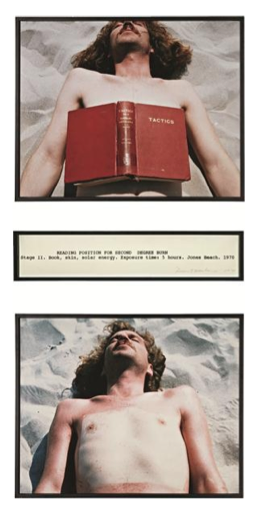
Dennis Oppenheim
Reading Position for Second Degree Burn, 1970. Jones Beach, New York. Skin Book, solar energy. Duration of Exposure: 5 hours – “The piece incorporates an inversion of reversal of energy expenditure. The body is placed in the position of recipient… an exposed plane, a captive surface. The piece has its roots in a notion of color change. Painters have always artificially instigated color activity. I allow myself to be painted – my ski becomes pigment. I can regulate its intensity through control of exposure time. Not only do the skin tones change, but change registers on a sensory level as well. I feel the act of becoming red.” D.O.
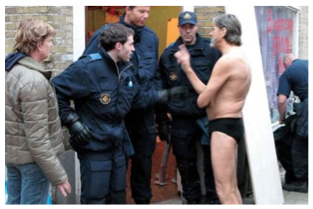
Ulay
Ulay towards the police that clear out a squat, stand up with the vulnerability of the naked body, 2006